
Ultrasound Training & Certification for Healthcare Providers
Feb 24, 2026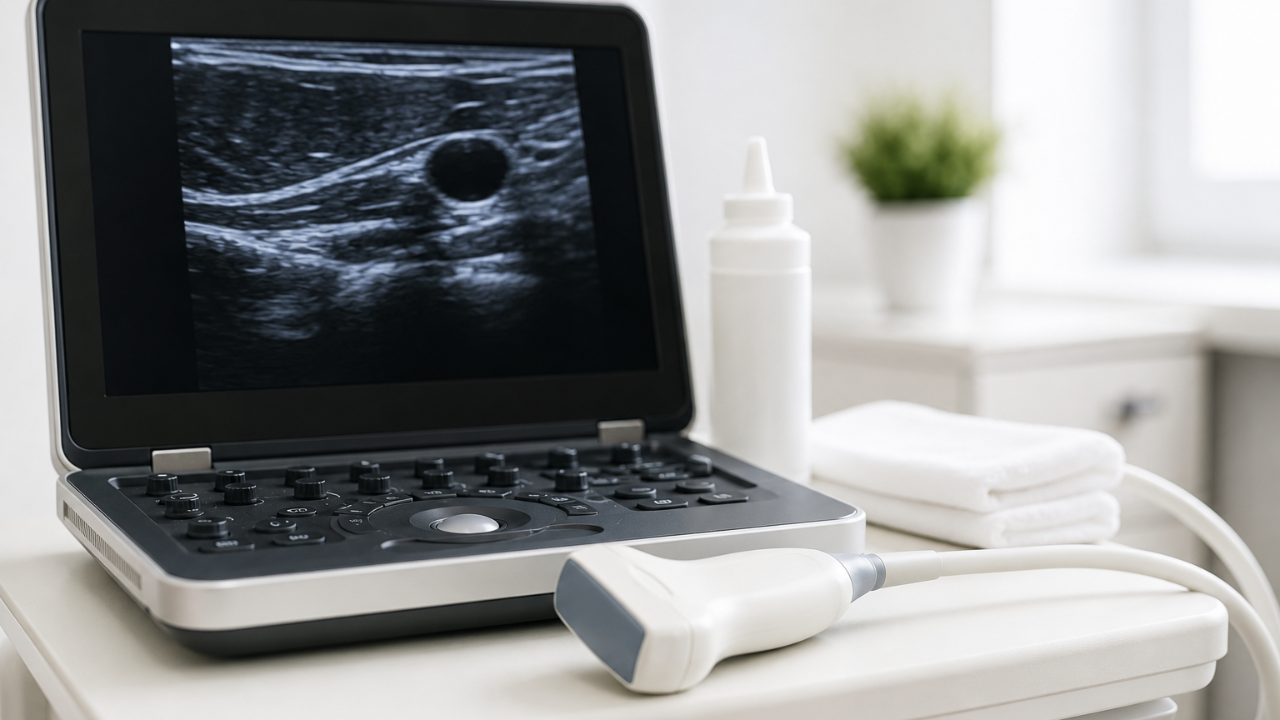
Ultrasound is no longer limited to radiology departments or hospitals. Now, point-of-care ultrasound (POCUS) is changing how healthcare providers assess patients, guide procedures, and make decisions in many specialties.
Providers in primary care, emergency medicine, functional medicine, sports medicine, regenerative medicine, IV therapy, and aesthetics are using ultrasound more often in daily practice. This helps them work more efficiently, perform procedures more accurately, and give patients a better experience. The growing use of ultrasound shows its expanding role in everyday care.
Portable ultrasound technology is now more affordable and easier to access. Providers who learn ultrasound skills gain an advantage in caring for patients and growing their practices. This is why ultrasound is becoming a practical tool in modern healthcare.
What Is Point-of-Care Ultrasound?
Point-of-care ultrasound means the clinician uses portable ultrasound during the patient visit. Unlike traditional imaging, which often needs a separate appointment and waiting for results, POCUS lets providers see anatomy in real time while examining the patient.
Ultrasound does not replace full imaging studies. Instead, it adds to the physical exam. It helps answer specific questions, speeds up decisions, and gives instant visual feedback during procedures. This makes POCUS especially helpful when quick, focused information is needed.
For patients, this usually means less waiting, faster answers, and more confidence in their care.
Related Course: The Ultrasound Essentials for Healthcare Providers course at Intellectual Medicine University teaches the basics of point-of-care ultrasound. It helps providers gain confidence in getting images, recognizing anatomy, and using ultrasound in different practice settings.
Ultrasound is now one of the most versatile tools for healthcare providers. Its use keeps growing across specialties because it allows real-time evaluation and helps guide procedures.
Primary care clinicians use ultrasound to assess soft-tissue problems, fluid buildup, and blood vessels. Emergency medicine providers use it to quickly assess very sick patients and guide procedures at the bedside. Sports medicine and orthopedic providers use ultrasound to examine muscles, tendons, ligaments, and joints as the patient moves.
Functional and regenerative medicine practices are using ultrasound more for vascular access, guided injections, and biologic procedures. In aesthetic medicine, ultrasound helps providers understand facial anatomy, make injections more accurate, and reduce the risk of vascular complications.
As more specialties use image-guided care, ultrasound is becoming a common skill and a practical part of daily clinical work. This change shows its growing importance in modern healthcare.
Why Does Ultrasound Improve Procedural Accuracy?
A major benefit of ultrasound is that it lets providers see anatomy directly during a procedure. When placing a hard IV, performing a joint injection, administering regenerative treatments, or assessing blood vessels, ultrasound helps providers locate key landmarks and monitor needle placement in real time.
Seeing the anatomy in real time can make procedures more precise, lower the number of needle attempts, and boost provider confidence, especially when the anatomy is complex or important structures need to be avoided.
Patients also like knowing their provider uses technology that improves safety and accuracy.
Clinical Pearl: Ultrasound guidance is becoming standard for many procedures because it lets providers see exactly where they are working instead of relying only on anatomical landmarks.
Can Ultrasound Improve Practice Efficiency?
Ultrasound not only improves procedures but also makes workflow smoother. In many practices, this extra efficiency is as valuable as the procedural benefits because it helps providers make decisions faster.
Since providers can get important information during the patient visit, ultrasound can help reduce delays in diagnosis and treatment. While MRI, CT, and formal ultrasound are still needed in many cases, point-of-care ultrasound lets providers answer specific questions right away and decide if more imaging is needed.
This often means a smoother experience for patients, fewer referrals, and more efficient decisions by providers.
For cash-based practices, adding ultrasound can expand services and give patients more value during their visit.
Why Is Proper Ultrasound Training Essential?
Like any advanced skill, ultrasound takes more than just buying equipment. Providers need structured learning before they can use it well in patient care, so training is an important next step.
Providers need to know how to choose the right probe, get clear images, recognize anatomy, guide procedures, and interpret results before using ultrasound in patient care. Without proper training, even the best equipment may not be used well or could lead to mistakes, which limits the value of ultrasound.
Formal training helps providers build confidence so they can use ultrasound responsibly and understand both its strengths and limits.
Related Course: The Ultrasound Essentials for Healthcare Providers course is designed for professionals who want to use ultrasound confidently in their practice. The course covers basics, musculoskeletal imaging, vascular access, guided procedures, regenerative medicine, IV therapy, aesthetic ultrasound, and practical imaging skills that can be used right away.
Ultrasound Is Also an Investment in Practice Growth
As patients learn more about healthcare technology, they look for providers who offer advanced, precise care. This demand gives practices another reason to use ultrasound and shows its wider value.
Adding ultrasound to your practice improves clinical decisions and also lets you expand services, boost patient satisfaction, and stand out in a competitive healthcare market.
Image-guided procedures often make patients feel more confident because they show precision, personal care, and a commitment to high standards. Ultrasound education today is positioning itself for the future of modern medicine.
Practice Insight: Ultrasound is more than just equipment. It is a clinical skill that can improve almost every patient visit when used the right way.
Final Thoughts
Healthcare is moving toward more precise, less invasive, and patient-focused care. Point-of-care ultrasound is a key part of this change because it lets providers see, diagnose, and guide procedures all in one patient visit.
No matter your specialty primary care, sports medicine, IV therapy, functional medicine, regenerative medicine, or aesthetics learning ultrasound skills can boost your confidence, make procedures more accurate, improve patient safety, and help your practice run more smoothly.
If you want to add ultrasound to your practice, the Ultrasound Essentials for Healthcare Providers course at Intellectual Medicine University offers practical, provider-focused training. With hands-on instruction and real-world examples, you will gain the skills and confidence to make ultrasound a key part of your daily work and improve your care.
References
- Moore CL, Copel JA. Point-of-care ultrasonography. N Engl J Med. 2011;364(8):749-757. doi:10.1056/NEJMra0909487.
- American College of Emergency Physicians. Emergency ultrasound guidelines. Ann Emerg Med. 2023;81(2):e1-e53.
- European Society of Radiology. ESR statement on portable ultrasound devices and point-of-care ultrasound. Insights Imaging. 2019;10(1):89. doi:10.1186/s13244-019-0775-x.
- American Institute of Ultrasound in Medicine. AIUM Practice Parameter for the Performance of Selected Ultrasound Examinations.
- American Medical Society for Sports Medicine. Position statement: Sports ultrasound. Br J Sports Med. 2021.