
Why Muscle Mass Is the Real Longevity Marker
Jun 25, 2026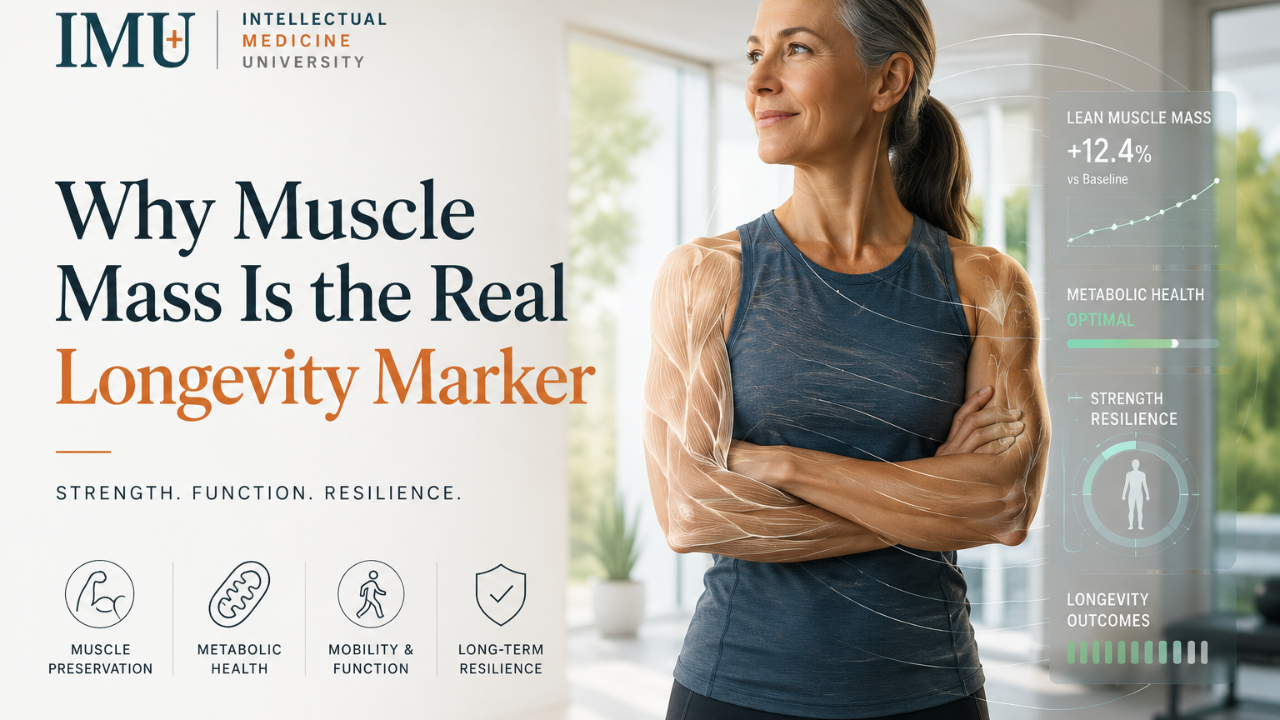
For years, healthcare conversations around aging have focused heavily on weight.
Patients are told to lower the number on the scale. Providers monitor BMI. Entire treatment plans are often centered around weight reduction alone.
But one of the biggest shifts happening in longevity medicine right now is the growing recognition that body weight by itself tells us very little about long-term health outcomes.
What matters far more is body composition.
And specifically: muscle mass.
Increasingly, research and clinical experience are pointing toward the same conclusion:
Muscle may be one of the most important predictors of healthy aging.
Not simply because it affects appearance or strength, but because muscle plays a central role in metabolic health, recovery capacity, insulin sensitivity, inflammation, mobility, and physiologic resilience.
And many providers are still underestimating how important that really is.
Muscle Is More Than Movement
Most people still think of muscle primarily in terms of athletic performance or aesthetics.
Clinically, however, skeletal muscle functions as a major metabolic organ.
Muscle influences glucose disposal, insulin sensitivity, mitochondrial health, inflammatory pathways, hormonal balance, metabolic flexibility, and recovery physiology. It also plays a critical role in protecting patients against frailty, falls, injury, and loss of independence as they age.
This is one reason low muscle mass is increasingly associated with worsening metabolic health, insulin resistance, cardiovascular risk, inflammation, frailty, and accelerated aging.
Research continues to support the relationship between skeletal muscle mass, metabolic function, and long-term health outcomes.
Patients may appear “healthy” based on body weight alone while simultaneously carrying dangerously low levels of lean muscle tissue underneath the surface.
And that is becoming a major issue in modern obesity medicine.
The Scale Can Be Misleading
One of the biggest mistakes in healthcare is relying too heavily on scale weight as the primary marker of success.
Patients can lose significant weight while simultaneously losing valuable lean muscle mass, especially during aggressive dieting, chronic calorie restriction, or poorly managed GLP-1 therapy.
On paper, the patient appears to be improving.
Physiologically, the opposite may be happening.
Muscle loss can reduce resting metabolic rate, impair insulin sensitivity, weaken recovery capacity, and increase long-term frailty risk. In some cases, patients become metabolically less resilient despite successful weight reduction.
This is why two patients with identical body weights may have dramatically different long-term health trajectories depending on their body composition.
The conversation around obesity medicine is beginning to shift away from simply asking:
“How much weight did the patient lose?”
Toward: “What kind of tissue did they lose?”
That distinction matters enormously.
Muscle Mass Directly Impacts Metabolic Health
One of the most important reasons muscle matters in longevity medicine is its direct relationship with metabolic function.
Muscle tissue acts as one of the body’s primary sites for glucose disposal and insulin sensitivity. Patients with higher amounts of lean muscle mass generally demonstrate better metabolic flexibility, improved glucose regulation, and stronger physiologic resilience overall.
Conversely, declining muscle mass is often associated with worsening insulin resistance, reduced energy expenditure, impaired recovery, and greater vulnerability to chronic disease progression.
This becomes especially important as patients age.
Beginning as early as the fourth decade of life, many adults gradually begin losing muscle mass through a process known as sarcopenia. Without intervention, this decline accelerates over time and contributes significantly to frailty, reduced mobility, loss of independence, and worsening metabolic health later in life.
Research on sarcopenia and aging continues showing that muscle preservation plays a critical role in maintaining long-term function and metabolic resilience.
Many patients are deeply concerned about looking older.
Clinically, providers should be equally concerned about patients becoming metabolically weaker.
Rapid Weight Loss Can Create Long-Term Problems
The rise of GLP-1 therapies has transformed obesity medicine in many positive ways.
But it has also exposed an issue many providers are still underestimating:
muscle preservation.
Patients losing weight rapidly without adequate resistance training, sufficient protein intake, or recovery support may lose substantial amounts of lean muscle tissue during treatment.
This is particularly concerning because many patients pursuing weight loss are already entering treatment with inadequate muscle reserves to begin with.
When muscle loss becomes excessive, patients often experience worsening fatigue, weakness, slower metabolism, impaired recovery, reduced physical performance, and increased long-term weight regain risk.
Providers who focus exclusively on short-term scale reduction may unintentionally compromise long-term metabolic resilience.
The goal should never simply be smaller body size.
The goal should be stronger physiology.
Research involving obesity treatment and metabolic adaptation increasingly supports the importance of preserving lean muscle mass during weight reduction interventions.
Longevity Is About Maintaining Function
One of the biggest misconceptions in healthcare is that longevity is simply about extending lifespan.
Patients do not just want to live longer.
They want to maintain:
- strength
- mobility
- cognition
- energy
- independence
- quality of life
Muscle plays a central role in all of those outcomes.
This is why many longevity experts now consider resistance training, adequate protein intake, sleep quality, recovery optimization, and metabolic health foundational pillars of healthy aging.
The conversation is shifting away from simply preventing disease and toward preserving physiologic performance across the lifespan.
And muscle sits at the center of that conversation.
Providers Need to Think Beyond Weight
Modern healthcare has spent decades overemphasizing weight while underemphasizing body composition.
That approach is finally beginning to change.
Providers who understand the relationship between muscle mass, insulin sensitivity, inflammation, recovery capacity, metabolic health, and aging will be significantly better positioned to help patients achieve sustainable long-term outcomes.
This requires a broader clinical framework that evaluates not just body weight, but overall physiologic resilience and functional capacity.
Because patients who maintain strength, muscle mass, and metabolic function as they age are often the patients who maintain independence and quality of life the longest.
The Future of Longevity Medicine Is Performance-Based
The future of preventative and longevity medicine will not simply focus on helping patients avoid disease.
It will focus on helping them maintain function.
That means preserving strength, muscle mass, metabolic flexibility, recovery capacity, and physical resilience throughout the aging process.
Providers who recognize muscle as a key longevity marker today will be far better prepared for the future of modern healthcare.
Because healthy aging is not just about living longer.
It is about remaining strong enough to fully live.
Want to Learn More About Longevity & Metabolic Medicine?
For providers looking to expand their knowledge and clinical application of longevity medicine, metabolic health, and body composition optimization, explore these related courses and documents from Intellectual Medicine University:
Semaglutide and Tirzepatide: Prescribing and Practice Growth
Learn practical implementation strategies for GLP-1 medications, including patient selection, dosing, side effect management, muscle preservation, and metabolic optimization.
https://www.imeduniversity.com/courses
Pharmacology for Effective Weight Loss
Explore the physiologic and pharmacologic foundations of sustainable obesity medicine, metabolic flexibility, and long-term body composition management.
https://www.imeduniversity.com/courses
CE-Accredited Functional Medicine Courses for NPs
Expand your understanding of inflammation, metabolic dysfunction, hormones, recovery physiology, and preventative medicine through practical clinical education.
https://www.imeduniversity.com/courses
Healthy Life eBook
Learn foundational lifestyle strategies for improving long-term wellness, including nutrition, hydration, movement, sleep, and mindset optimization. Ideal for providers looking to enhance patient education, strengthen engagement, and support sustainable health outcomes through lifestyle-focused care.
Intellectual Medicine University
Related References
Wolfe RR. The underappreciated role of muscle in health and disease. American Journal of Clinical Nutrition. 2006.
The underappreciated role of muscle in health and disease - ScienceDirect
Churchward-Venne TA, Murphy CH, Longland TM, Phillips SM. Role of Protein and Exercise in the Maintenance of Muscle Mass During Weight Loss in Older Adults. Current Opinion in Clinical Nutrition and Metabolic Care. 2013.
https://journals.lww.com/co-clinicalnutrition/Abstract/2013/01000/Role_of_protein_and_exercise_in_the_maintenance.4.aspx
Wilding JPH, Batterham RL, Calanna S, et al. Once-Weekly Semaglutide in Adults with Overweight or Obesity. New England Journal of Medicine. 2021.
https://www.nejm.org/doi/full/10.1056/NEJMoa2032183
Blüher M. Obesity: global epidemiology and pathogenesis. Nature Reviews Endocrinology. 2019.
https://www.nature.com/articles/s41574-019-0176-8
Hall KD, Kahan S. Maintenance of Lost Weight and Long-Term Management of Obesity. Medical Clinics of North America. 2018.
https://www.medical.theclinics.com/article/S0025-7125(17)30136-0/fulltext